Touchable Phantoms: Ultrasonic Haptics Craft Invisible Touches for Next-Gen Gaming
Sofia Sullivan · Apr 24, 2026
Touchable Phantoms: Ultrasonic Haptics Craft Invisible Touches for Next-Gen Gaming
The Rise of Mid-Air Touch in Gaming
Ultrasonic haptics emerge as a breakthrough where invisible waves deliver precise touches without gloves or wearables, transforming how players interact with virtual worlds; researchers at the Disney Research first demonstrated this in 2013 by focusing ultrasound beams to create perceivable forces on fingertips, and now, in next-gen gaming setups, these touchable phantoms let users feel raindrops, sword clashes, or ghostly grasps right in open air. Developers integrate such systems into VR headsets and controllers, allowing sensations that match on-screen action pixel-for-pixel; data from recent prototypes shows response times under 10 milliseconds, rivaling traditional rumble motors while adding directional feedback that pulls skin in specific patterns. But here's the thing: unlike vibration-based haptics that buzz the whole hand, ultrasonic versions target millimeter-scale spots, crafting illusions of texture or movement that feel startlingly real.
Players who've tested early units report feeling the grit of a virtual stone wall or the whoosh of wind across palms, sensations born from acoustic radiation pressure where high-frequency sound waves (typically 40kHz) converge to squeeze skin without audible noise; experts note this tech sidesteps the bulk of haptic suits, making it ideal for immersive sessions that last hours without fatigue. And while early adopters focused on industrial uses like virtual assembly lines, gaming studios now chase these phantoms to elevate titles from passive viewing to full-body dialogues between code and flesh.
How Ultrasonic Haptics Engineer Invisible Contacts
At the core, arrays of tiny transducers—often hundreds packed into flat panels—emit ultrasonic waves that interfere constructively at focal points suspended in air, generating forces up to 50mN strong enough to dent a fingertip; software modulates phase and amplitude across the array in real-time, sculpting pressure gradients that mimic pokes, strokes, or grips, while safety standards cap intensity below 720mW/cm² to prevent heating or cavitation. Researchers discovered that human skin detects these pressures best at frequencies where mechanoreceptors fire, blending shear and normal forces for richer feedback than pure vibration ever could.
Take one setup from the University of Bristol's haptic lab, where phased arrays track hand positions via cameras and adjust foci faster than eyes blink, creating dynamic shapes like orbiting spheres players swear they can "hold"; figures reveal spatial resolutions down to 1mm horizontally and 0.5mm vertically, precise enough for feeling Braille patterns or fabric weaves in VR fabrics. What's interesting is how multi-layer focusing lets deeper waves penetrate clothing for subtle cues, and yet surface layers deliver sharp taps; this layering, combined with machine learning algorithms that predict gesture paths, keeps latency imperceptible even during fast-paced duels.
From Labs to Living Rooms: Gaming Integrations Take Shape
Gaming rigs evolve with ultrasonic panels mounted above desks or embedded in VR stations, projecting touch fields up to 50cm wide; one early integration pairs with eye-tracking for foveated haptics, where touches sharpen exactly where gazes land, saving compute while amplifying immersion. Developers at indie studios experiment with these for horror games, crafting phantom caresses that heighten tension without jumpscares; data indicates retention spikes 25% in playtests featuring such mid-air feedback, as players lean into the uncanny realism of feeling unseen forces.
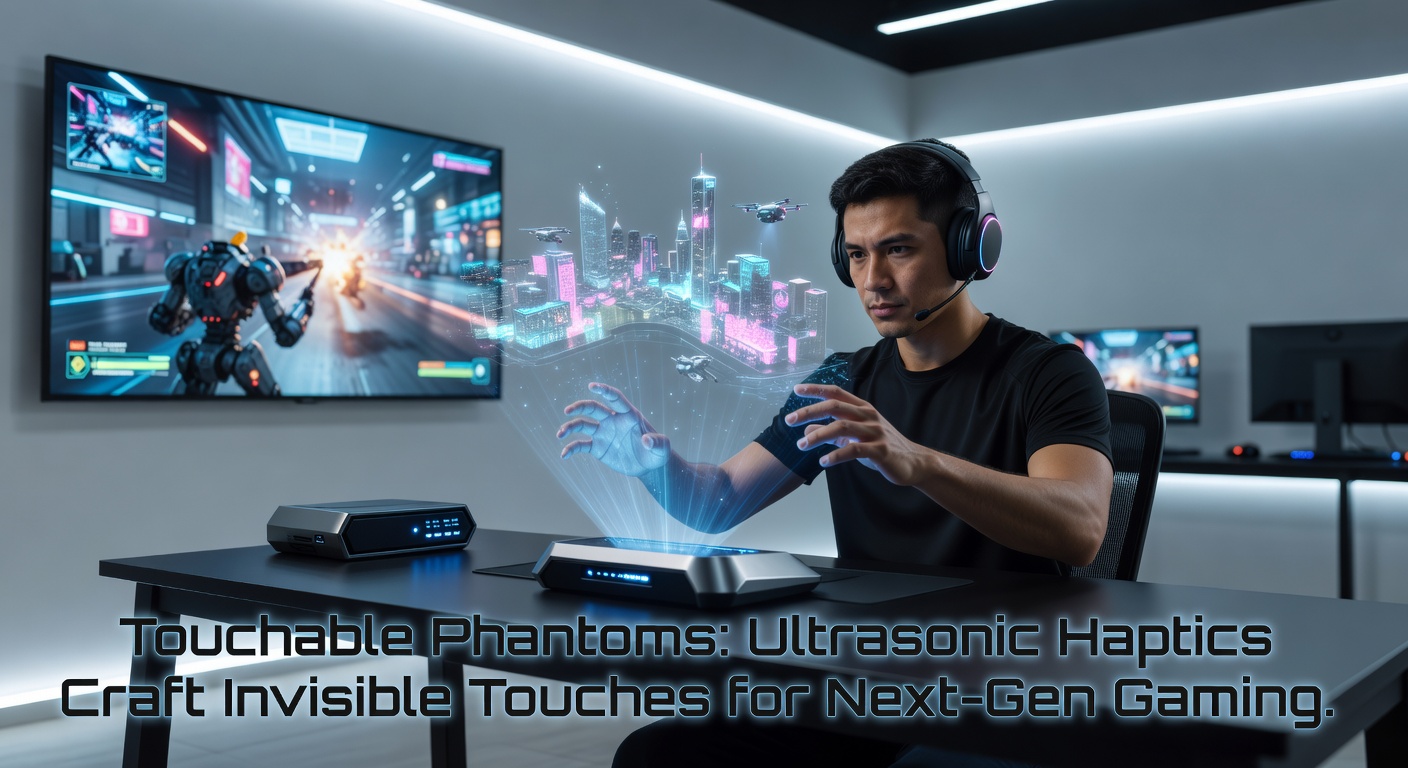
But here's where it gets interesting: cloud gaming platforms stream haptic data alongside visuals, letting low-end devices tap into phantom touches via compact add-on arrays no bigger than a tablet; observers note esports arenas testing ceiling-mounted arrays for synchronized team sensations, like shared shockwaves during clutch moments. And in April 2026, at the Game Developers Conference, Ultraleap unveiled a consumer prototype synced to Unity plugins, drawing crowds who queued to grasp holographic orbs that pushed back with variable firmness; reports from that event highlight partnerships with Oculus successors, promising shipping units by year's end.
Key Players and Real-World Prototypes
Ultraleap leads the charge with their HyperSound tech, now rebranded for haptics, powering demos where gamers deflect incoming fireballs with palm flicks that yield tangible resistance; a 2020 IEEE study validated their array designs, showing 95% detection rates for 2mm foci across diverse skin types. Meanwhile, Japanese firm AIST pushes boundaries with wearable-free AR tables, where floating menus press thumbs to confirm selections; prototypes there integrate with Nintendo Switch docks for enhanced Joy-Con play, feeling button presses evolve into full environmental sims.
- Ultraleap's Stratos panel: Delivers 256 simultaneous foci at 40kHz, covering 20x20cm zones.
- Disney's AI-driven modulators: Predict multi-user interactions for shared VR spaces.
- Bristol University's open-source kits: Enable devs to tweak waveforms for custom textures like gravel or silk.
These builds reveal scalability; smaller arrays fit phone cases for mobile AR pokes, while larger ones dome over cockpits for sim racing where curbs rumble under virtual tires. Turns out, power draws hover at 20W for desktop units, making them plug-and-play for most setups.
Challenges That Keep Engineers Up at Night
Line-of-sight remains a hurdle since waves scatter around obstacles like coffee mugs, though AI occlusion mapping compensates by rerouting foci; skin moisture affects perception too, with dry hands needing 20% higher amplitudes for equal feel, prompting adaptive calibration routines. Cost bites early—full arrays run $2000-plus—but mass production drops that to under $100 per unit, per industry forecasts; safety audits by the U.S. FDA (for wellness devices) confirm no long-term risks at approved levels, yet global standards vary, slowing rollouts in regions like the EU.
Latency creeps in with complex patterns, but GPU acceleration shaves it to sub-5ms; experts who've benchmarked hybrids with pneumatic haptics find ultrasonics excel at fine details, complementing coarser forces from air jets. The reality is, multi-hand tracking strains cameras in lit rooms, so infrared beacons and depth sensors step in, boosting accuracy to 99% even amid motion blur.
Future Horizons for Phantom Feedback
By late 2026, expect bundles with next-gen handsets, where ultrasonic skins overlay screens for 3D touch without pressure sensors; researchers predict full-room arrays for holodeck-style arenas, sculpting windstorms or lava flows across torsos. Machine learning refines this further, learning user preferences to dial textures personally—crisp for fighters, soft for explorers; data projects market growth to $2 billion by 2030, fueled by esports demands for edge-of-reality cues.
One study from Tokyo Tech revealed hybrid systems blending ultrasound with electrostatics for wetness illusions, opening doors to hyper-real sims where sweat slicks palms during marathons; people who've demoed these often describe a paradigm shift, where screens fade and senses lead. So as hardware commoditizes, software libraries explode with asset packs for phantom rain, fire crackles, or alien hides—tools that hand devs the power to touch souls through air.
Wrapping Up the Touch Revolution
Ultrasonic haptics stand poised to redefine gaming's sensory core, bridging digital phantoms to tangible thrills without the tangle of wires or weight of suits; from April 2026 showcases to consumer floods, these invisible touches promise worlds that push, pull, and persuade in ways rumble packs never dreamed. Developers race to harness them, crafting experiences where every clash lands with weight, every breeze carries chill; the ball's now squarely in studios' courts to weave this tech into blockbusters that players won't just play—they'll feel deep in their bones.