Pathfinding Algorithms Powering Believable Crowds in Modern Simulations
Sofia Sullivan · Jul 19, 2026
Pathfinding Algorithms Powering Believable Crowds in Modern Simulations
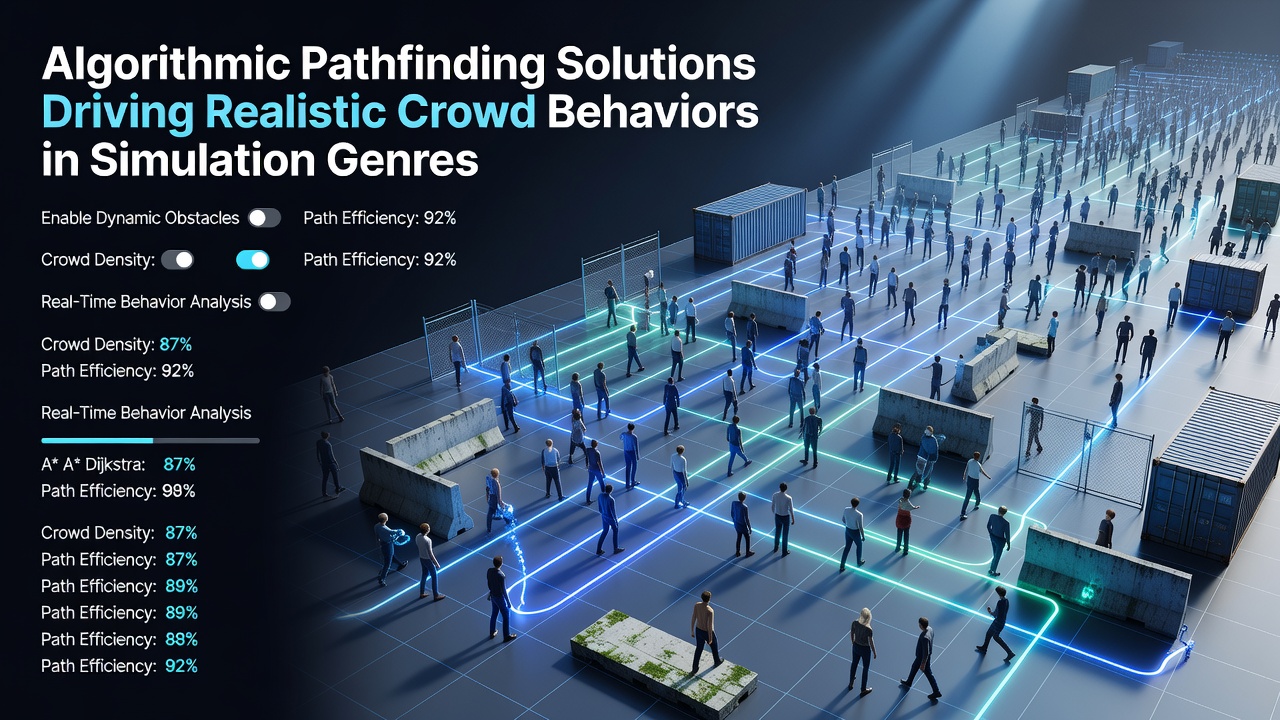
Simulation genres have long relied on sophisticated pathfinding methods to create convincing group movements, and developers continue refining these systems as computational resources expand. Techniques such as A* search, navigation meshes, and hierarchical pathfinding allow thousands of agents to traverse environments without unnatural clustering or collisions, and data from industry reports indicate these approaches have become standard in titles released through mid-2026.
Core Algorithms Behind Agent Navigation
Researchers at institutions across North America and Europe have documented how A* variants combined with flow field calculations enable efficient routing for large populations. These methods calculate optimal routes while accounting for dynamic obstacles, and they scale effectively when integrated with GPU acceleration. Studies from the University of Waterloo highlight performance gains when pathfinding layers operate at multiple resolutions simultaneously, allowing broad strategic decisions at one level and fine local adjustments at another.
Navigation Meshes and Dynamic Updates
Navigation meshes divide game spaces into walkable polygons that agents query in real time. When environments change, such as through construction events or weather effects, the meshes update incrementally rather than recomputing entirely. This incremental approach reduces processing overhead and maintains frame rates even as crowd density rises. Observers note that games like city builders released in 2025 adopted these mesh refinements to handle peak-hour traffic simulations without visible pathing errors.
Behavioral Layers and Social Awareness
Pathfinding alone does not produce realistic crowds, so developers layer additional rules for personal space, group cohesion, and goal prioritization. Reciprocal velocity obstacles and social force models adjust trajectories based on nearby agents, and evidence from academic papers shows these additions reduce the robotic appearance of movement patterns. In July 2026, several simulation platforms incorporated machine learning classifiers trained on real pedestrian footage to tune these behavioral parameters automatically.
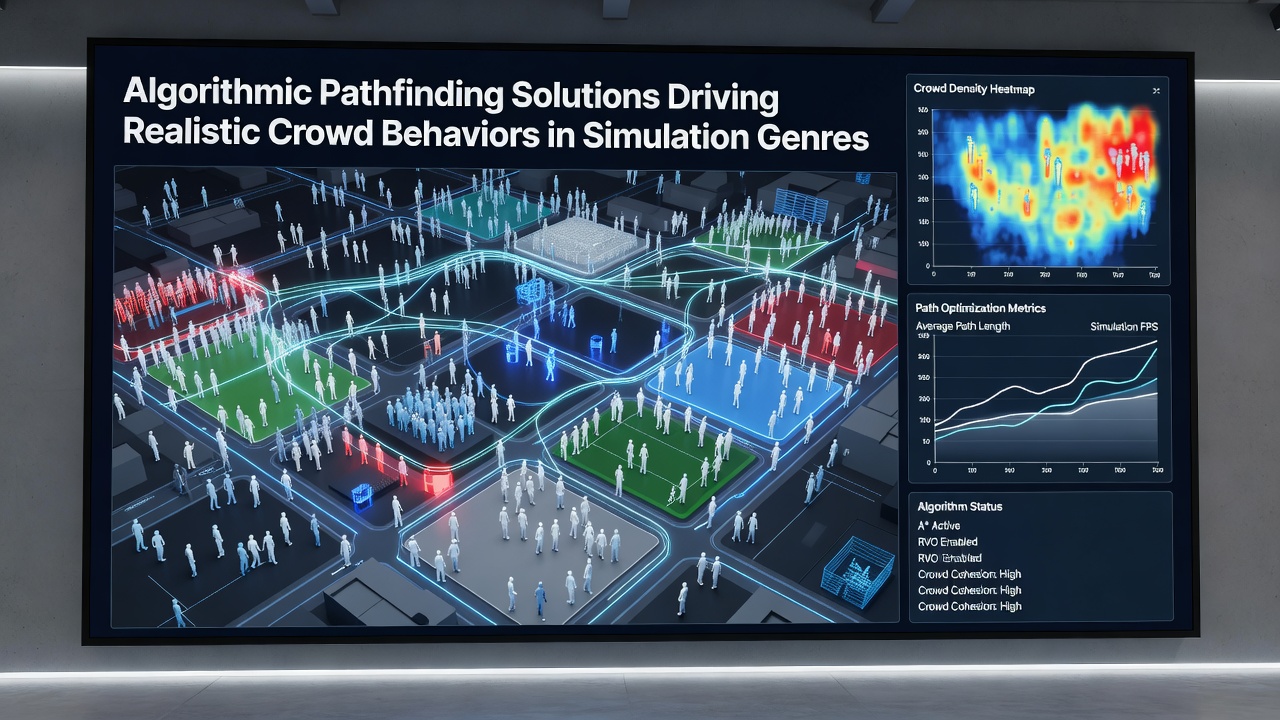
One study conducted at an Australian research center revealed that agents equipped with both pathfinding and simple social awareness routines formed natural queues at bottlenecks, whereas pure pathfinding implementations produced visible jams. These findings prompted several studios to adopt hybrid systems that blend geometric navigation with lightweight decision trees.
Performance Scaling in Large Environments
Handling populations exceeding ten thousand agents requires careful memory management and parallel processing. Hierarchical pathfinding divides maps into sectors, so agents first solve coarse routes across sectors before refining within each one. Benchmarks published by European gaming technology consortia demonstrate that this hierarchy cuts search times by factors of five to ten compared with flat implementations. Cloud-based simulation tools emerging in 2026 further offload path calculations to remote nodes, freeing local hardware for rendering and physics.
Integration with Procedural Content
When worlds generate procedurally, pathfinding graphs must adapt on the fly. Developers embed connectivity checks during terrain generation so that newly created structures automatically connect to existing navigation data. This integration prevents unreachable areas and maintains consistent agent flow across sessions. Figures from industry analyses indicate that procedural titles using these techniques achieve higher player retention because crowds continue behaving naturally even after extensive world alterations.
Case Examples from Released Titles
Take one popular life simulation series that updated its engine in 2025; the patch introduced improved flow field calculations that allowed festival crowds to disperse smoothly after events. Another city management game released updates in early 2026 that applied multi-agent pathfinding to emergency response units, resulting in faster simulated rescue times during disaster scenarios. Those who've examined telemetry data from these titles report fewer player complaints about stuck or looping characters.
Links to external research provide further context. A report from the Government of Canada innovation portal outlines computational requirements for real-time crowd systems, while a paper hosted by the Swinburne University of Technology details behavioral extensions to classic A* methods.
Conclusion
Algorithmic pathfinding continues evolving alongside hardware capabilities, and the combination of geometric navigation with behavioral models now supports increasingly dense and varied crowds in simulation experiences. As new titles launch throughout 2026 and beyond, these underlying solutions remain central to delivering environments where populations move with convincing purpose and fluidity.