Neural Rendering Transforms Indie Game Worlds with Real-Time Photorealism on Everyday Hardware
Devon Schwarz · Jul 26, 2026
Neural Rendering Transforms Indie Game Worlds with Real-Time Photorealism on Everyday Hardware
Neural rendering techniques have begun shifting how indie studios approach visual fidelity, allowing real-time photorealistic environments to run on hardware that previously supported only stylized graphics. These methods combine machine learning models with traditional rasterization pipelines, which reduces the computational load while preserving detail in lighting, textures, and geometry.
Core Mechanisms Behind the Shift
Researchers have developed neural radiance fields and related architectures that interpolate scene data from sparse inputs, and these tools now integrate directly into game engines through plugins and middleware. Data from multiple viewpoints trains compact models that generate novel views on the fly, which cuts down on precomputed asset storage requirements that once limited smaller teams.
Engine updates released in early 2025 incorporated optimized inference paths for consumer GPUs, and indie developers quickly adopted them for projects targeting mid-range laptops and integrated graphics solutions. Performance benchmarks released by hardware vendors show frame rates above 60 FPS in scenes with dynamic global illumination, even when running on cards with 4 GB of VRAM.
Practical Applications in Independent Development
Small studios have applied neural rendering to open-world prototypes where procedural generation meets learned detail enhancement, and this combination lets artists focus on high-level design rather than manual texture work. One team working on a narrative exploration title replaced dozens of hand-authored light probes with a single neural model that adapts to player movement in real time.
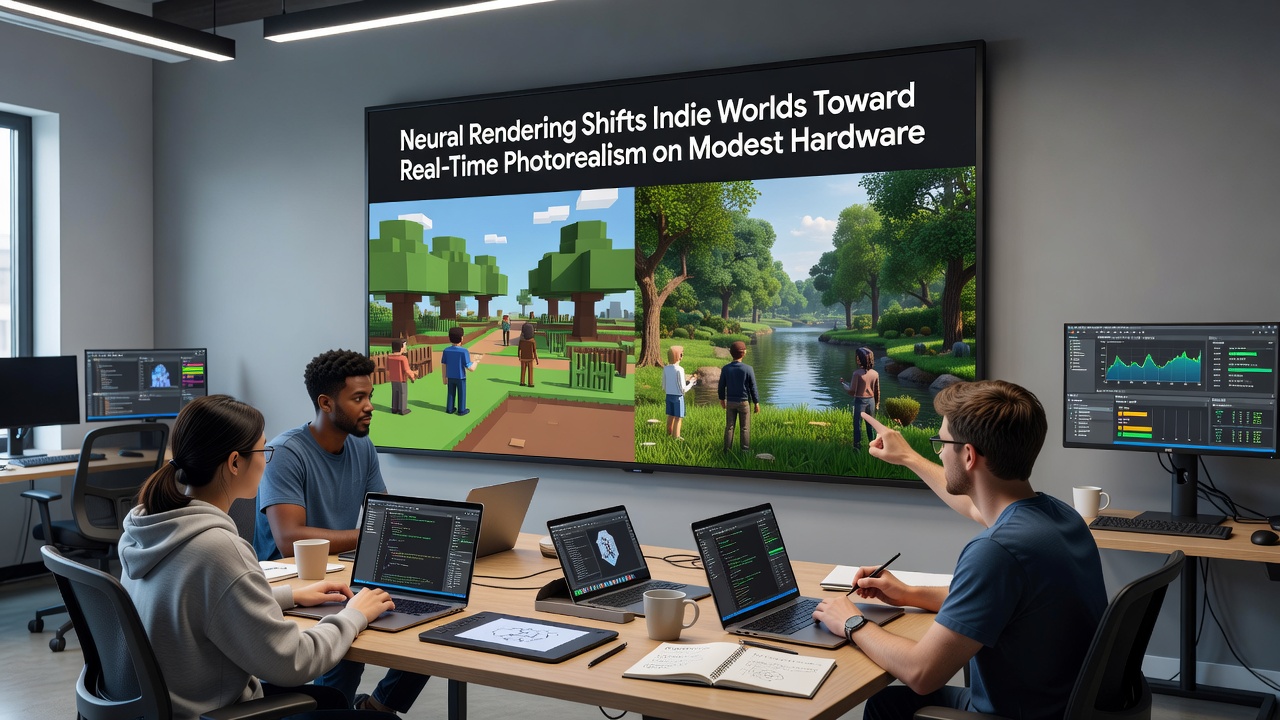
Academic studies conducted at institutions across North America and Europe document similar efficiency gains, and figures from those papers indicate memory usage reductions of up to 70 percent compared with equivalent pre-baked solutions. Developers in Australia and Canada have reported parallel results when targeting export to handheld consoles and older desktop systems still common in emerging markets.
Industry Data and Adoption Trends
Reports compiled by regional trade organizations such as the International Game Developers Association track rising participation in neural rendering workshops throughout 2025 and into July 2026, with attendance numbers doubling year over year. These sessions emphasize integration steps that require only modest coding experience, which aligns with the skill profiles of many solo and small-team creators.
Another analysis from the European Games Developer Federation highlights how licensing costs for commercial neural tools have declined, opening access for projects with limited budgets. The same document notes that several titles using these methods reached Steam without requiring players to own dedicated graphics cards beyond entry-level models released in 2023.
Technical Constraints and Ongoing Refinements
Limitations remain around training time for complex scenes and occasional artifacts during rapid camera motion, yet continuous model compression research addresses these issues through quantization and pruning techniques. Observers note that hybrid pipelines, where neural components handle only specific effects such as reflections or foliage density, currently deliver the most stable results across varied hardware configurations.
Engine documentation from major providers outlines best practices for fallback rendering paths that maintain visual coherence when inference resources drop below thresholds, and this layered approach has proven reliable in multiplayer test environments.
Conclusion
Neural rendering continues to expand the visual vocabulary available to independent creators by lowering hardware barriers that once separated indie productions from larger studio outputs. As integration pathways mature and supporting datasets grow, the technology supports broader experimentation while preserving compatibility with existing distribution platforms and player hardware bases.