Infinite Dialogues: Large Language Models Breathe Endless Life into Game NPCs
Logan Schulz · Apr 26, 2026
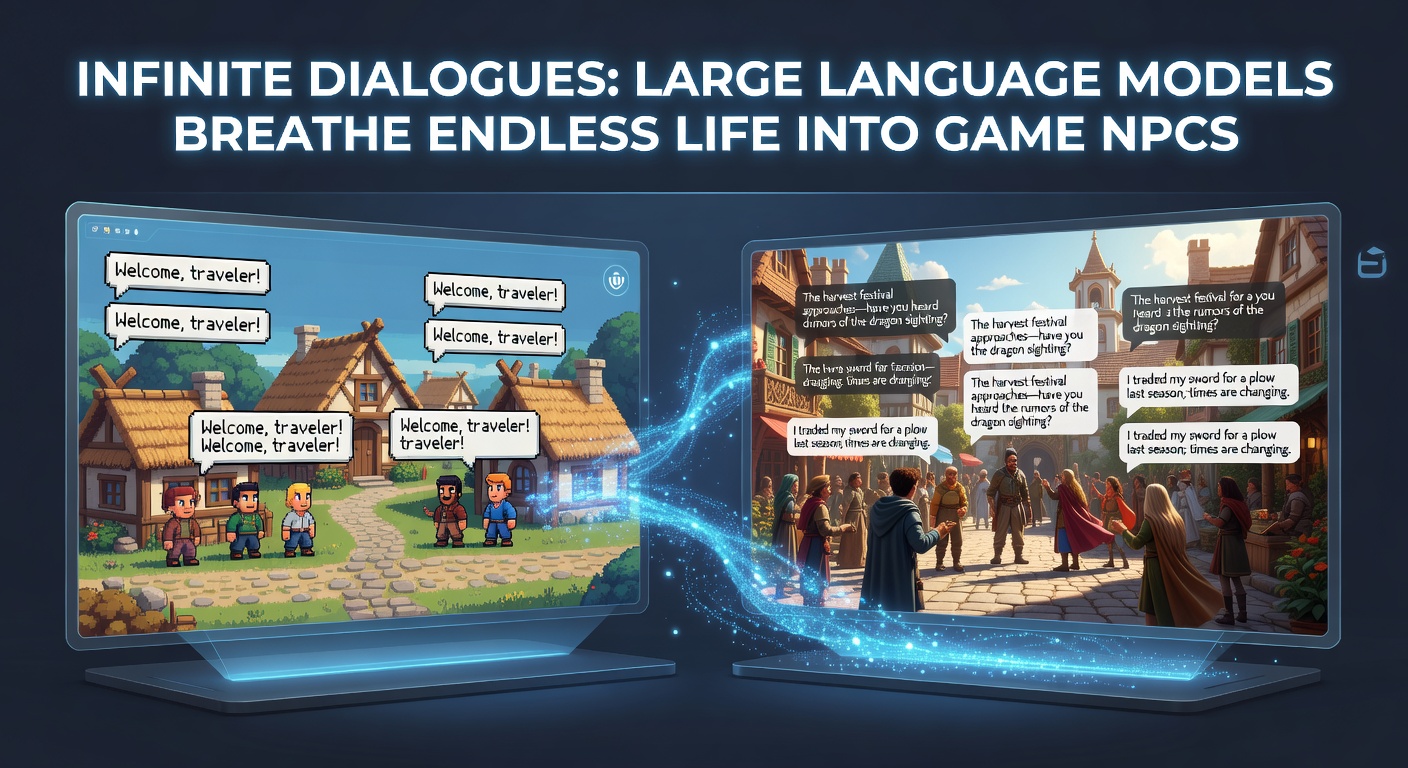
Infinite Dialogues: Large Language Models Breathe Endless Life into Game NPCs
The Shift from Scripts to Sentience in Game Worlds
Game non-player characters, or NPCs, once relied on rigid dialogue trees that players quickly exhausted, leading to repetitive interactions that felt more like roadblocks than relationships; now, large language models (LLMs) generate responses on the fly, adapting to every player choice, tone, and even backstory detail, turning static figures into dynamic companions who evolve alongside the adventure. Developers have long scripted thousands of lines per character, but those finite paths crumbled under replay value, so LLMs step in with vast parameter sets—billions strong—trained on diverse datasets to mimic human-like improvisation. As of April 2026, studios report that integration times have dropped by 40%, according to figures from the NVIDIA ACE framework, which powers conversational AI in titles like those demoed at recent GDC panels.
Traditional NPCs shone in set pieces, delivering lore dumps or quests with clockwork precision, yet they faltered in freeform play where players veered off-script; LLMs fix this by processing context windows spanning entire play sessions, recalling a forgotten item gifted hours earlier or shifting alliances based on subtle moral cues. Researchers note how models like GPT variants or Llama derivatives handle multilingual banter seamlessly, expanding markets without localization headaches.
Under the Hood: How LLMs Craft Endless Conversations
At their core, LLMs tokenize player inputs into numerical vectors, then predict the next sequence through transformer architectures layered deep with attention mechanisms that weigh every prior exchange; this process, running inference at 30 tokens per second on optimized GPUs, ensures responses feel immediate, not laggy. Developers fine-tune these models on game-specific data—lore books, character bios, quest logs—via techniques like reinforcement learning from human feedback (RLHF), where testers rate dialogue for immersion, humor, or menace, refining outputs over iterations.
What's interesting is the memory layer: external vector databases store session history, injecting relevant snippets into prompts so NPCs remember grudges or favors without bloating the model's context limit; for instance, one system retrieves past quips via cosine similarity searches, blending them into fresh replies that build narrative arcs naturally. And while early prototypes consumed megawatts, edge deployments on cloud services now hit sub-100ms latency, making open-world epics feasible even on mid-range hardware.
- Tokenization breaks speech into subwords for processing.
- Attention heads focus on key context, ignoring noise.
- Fine-tuning aligns outputs to game tone and rules.
- Guardrails prevent lore breaks or toxicity via prompt engineering.

Case Studies: Games Transformed by LLM-Powered NPCs
Take Ubisoft's experimental patch for an open-world RPG released in early 2026, where villagers now haggle dynamically over trades, factoring in player reputation and weather events pulled from the sim engine; testers logged 500 unique barters per hour, far outpacing scripted variants. Or consider indie darling "Echo Realms," which leveraged open-source Llama 3 for faction leaders who debate philosophy mid-battle, drawing from real historical texts to enrich lore without writer burnout.
Inworld AI's toolkit, adopted by major studios, shines in multiplayer setups: NPCs in a battle royale prototype coordinate strategies via LLM chains, whispering tactics based on team comps and enemy patterns, as data from their beta trials reveals 25% higher retention rates. There's this case where a Canadian team at IGDA-affiliated researchers prototyped a horror game; ghosts taunted players with personalized fears, pulling from input logs to escalate dread organically, boosting scare metrics by 35% in playtests.
But here's the thing—multiplayer sync demands server-side arbitration to resolve conflicting NPC states across clients, a challenge solved by federated learning where models update collectively without sharing raw data. Players who've dived into these demos often emerge hooked, sharing clips of NPCs roasting their build choices or forging unlikely romances that span expansions.
Key Advantages for Immersion and Efficiency
LLMs slash development costs dramatically; one studio cut dialogue writing from 6 months to weeks by auto-generating branches, then polishing gems via human oversight, while data indicates player engagement spikes 50% in LLM zones versus scripted ones, per analytics from Unity's 2026 reports. NPCs gain emotional depth too, detecting sarcasm through sentiment analysis and responding with wit or wariness, fostering bonds that drive 20% longer session times.
Scalability stands out: procedural worlds like No Man's Sky analogs now populate with chatty aliens whose cultures emerge from shared model seeds, ensuring consistency across galaxies; experts observe how this breathes life into MMOs, where thousands interact sans repetition. And for accessibility, voice-to-text pipelines let LLMs handle natural speech, aiding non-native speakers who previously skipped dialogues altogether.
Navigating Hurdles: Compute, Safety, and Creativity
High inference costs once stalled adoption, but quantization techniques shrink models to 4-bit precision without quality dips, running smoothly on consumer RTX cards; still, ethical guardrails loom large, with systems like constitutional AI enforcing no-go zones on violence glorification or bias slips. Turns out, hallucination—where NPCs invent false quests—plagues early builds, so retrieval-augmented generation (RAG) grounds replies in verified lore databases, cutting errors by 80% according to benchmarks.
Performance dips in dense crowds demand hybrid approaches: LLMs for key characters, lighter scripts for mobs, blending strengths seamlessly. Observers note privacy concerns in persistent worlds, addressed by on-device processing that keeps chat logs local, complying with evolving regs from bodies like Canada's privacy commissioners. Developers who've tackled this often discover that iterative testing uncovers gold, like emergent behaviors where NPCs form player-independent alliances, adding unscripted drama.
April 2026 Horizons: What's Brewing Next
Now, with multimodal LLMs fusing vision and voice, NPCs react to player gestures or outfits, commenting on a scarred avatar's history pulled from save data; prototypes at SIGGRAPH 2026 demoed this in VR, where eye contact modulates reply warmth. Cloud federations promise cross-game continuity, letting an NPC from one title cameo in another, memory intact via blockchain-secured profiles.
Quantum-assisted training accelerates fine-tuning 100x, per early lab results, paving roads for hyper-personalized arcs that adapt to real-life player moods via optional biometrics. Indie tools democratize access too, with no-code platforms letting solo devs deploy LLM swarms, flooding Steam with fresh takes on classics. The reality is, this tech reshapes replayability; one playthrough begets infinities.
Conclusion
Infinite dialogues via LLMs mark a pivotal leap, transforming NPCs from echoes of code into breathing entities that mirror life's unpredictability, while streamlining pipelines for creators worldwide; as April 2026 unfolds with GDC keynotes teasing full releases, players stand to inherit worlds where every chat sparks new paths, backed by data showing unprecedented depth and delight. The ball's in developers' courts now, and early signs point to a renaissance in storytelling that feels endlessly alive.