Custom Silicon Designs Ignite Real-Time Ray Tracing in Next-Generation Handhelds
Devon Schwarz · Jul 12, 2026
Custom Silicon Designs Ignite Real-Time Ray Tracing in Next-Generation Handhelds
Custom silicon has emerged as the driving force behind real-time ray tracing in portable gaming hardware, where traditional discrete GPUs fall short on power and thermal constraints. Manufacturers now embed dedicated ray tracing cores directly into system-on-chip designs, enabling complex light simulation without draining batteries or generating excess heat. These architectures process ray-triangle intersections and shading calculations through specialized pipelines that operate alongside general-purpose graphics units.
Research from institutions across multiple regions shows steady progress in mobile ray tracing hardware since 2024, with several prototypes reaching commercial viability by mid-2026. Data indicates that custom ASICs reduce ray tracing overhead by factors of three to five compared with software-based approaches on standard mobile GPUs. Engineers achieve this efficiency through fixed-function units that handle bounding volume hierarchy traversal and intersection testing in hardware rather than relying on programmable shaders alone.
Architectural Shifts in Portable Silicon
Handheld devices demand silicon that balances performance with strict energy budgets, prompting designers to integrate ray tracing accelerators as tightly coupled co-processors rather than standalone modules. These units share memory hierarchies with CPU and GPU cores, minimizing data movement that would otherwise consume additional power. Observers note that recent designs incorporate variable-rate ray casting, which adjusts sampling density based on scene complexity and screen region importance, further conserving resources during gameplay.
By July 2026 multiple fabrication nodes had reached production volumes suitable for handheld volumes, allowing vendors to ship devices with hardware ray tracing support at 1080p and higher internal resolutions. Engineers combine these accelerators with advanced process technologies below seven nanometers, which deliver the transistor density required for thousands of parallel ray processing elements while fitting within compact die sizes.
Ray Tracing Pipeline Optimizations
Real-time ray tracing on handhelds relies on hybrid rendering pipelines that combine rasterization for primary visibility with ray tracing for reflections, shadows, and global illumination. Custom silicon implements denoising filters and temporal accumulation in dedicated hardware blocks, which reduces the number of rays needed per pixel to achieve acceptable image quality. Studies conducted at European research centers demonstrate that these hardware denoisers cut required ray counts by up to sixty percent without introducing noticeable artifacts in fast-motion sequences.
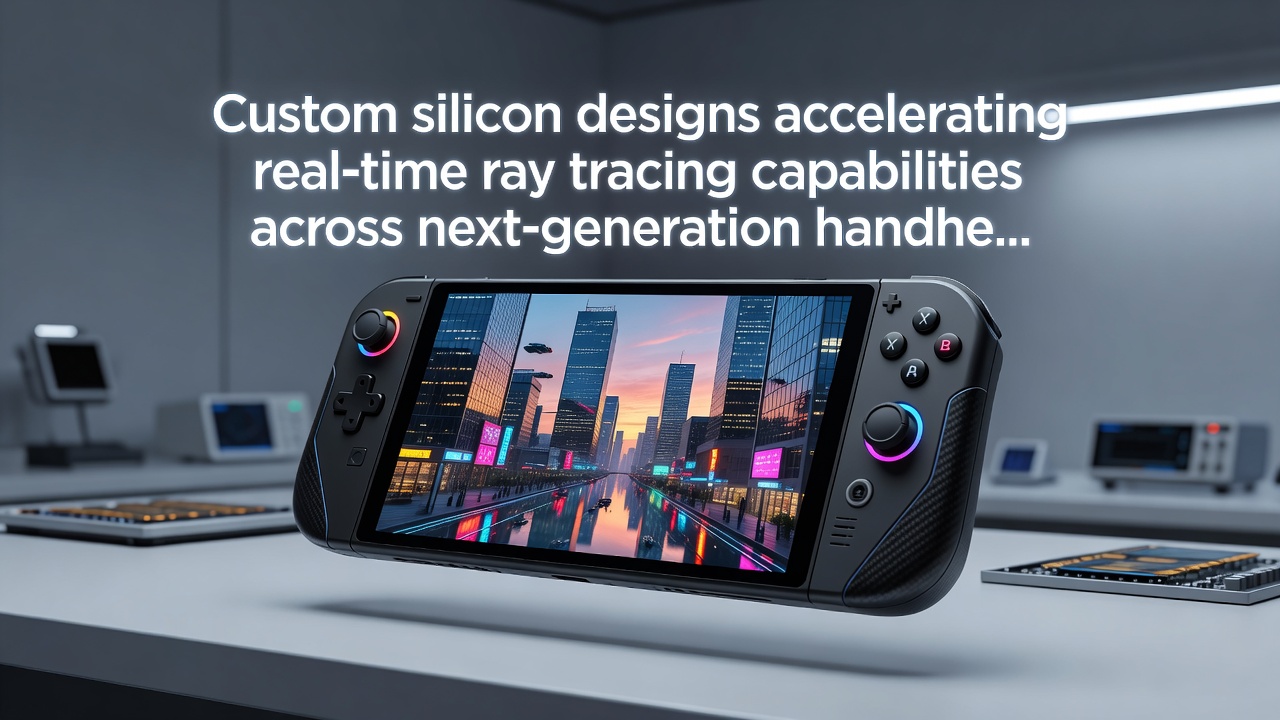
Developers leverage these capabilities to implement effects previously reserved for high-end desktop systems. Reflections now update at interactive rates even when characters move through detailed indoor environments, and dynamic shadows respond to multiple moving light sources without precomputed maps. The silicon handles path tracing extensions in limited scenarios, such as short cinematic sequences where frame rates can drop temporarily to prioritize visual fidelity.
Industry Adoption and Implementation Examples
Leading handheld platforms have incorporated these custom designs into upcoming revisions scheduled for late 2026 release. One manufacturer integrated a ray tracing block capable of tracing four rays per pixel at 60 frames per second while maintaining under eight watts of total system power. Another approach pairs the accelerator with machine-learning upscaling techniques that reconstruct full-resolution images from lower internal render targets, preserving battery life during extended play sessions.
Academic papers published through North American universities document performance metrics across several test scenes, confirming that hardware-accelerated ray tracing now achieves parity with previous-generation console visuals on devices weighing less than 500 grams. Trade organizations tracking semiconductor trends report increasing allocation of die area to ray tracing units, rising from under five percent in 2023 designs to over twelve percent in current handheld silicon.
Thermal and Power Management Considerations
Heat dissipation remains a critical constraint in compact form factors, so custom silicon includes dynamic frequency scaling that modulates ray tracing throughput based on measured temperature and remaining battery capacity. When thermal limits approach thresholds, the hardware gracefully reduces ray counts or switches to simplified shading models while preserving core gameplay functionality. This adaptive behavior stems directly from on-die sensors and control logic that monitor workload distribution in real time.
Power delivery networks have also evolved to support bursty ray tracing workloads, with multiple voltage domains allowing the accelerator to operate at higher clocks during short rendering peaks without affecting the rest of the system. Figures from industry reports reveal that average power draw for ray tracing workloads has declined steadily, enabling four-to-six-hour play times even when advanced lighting effects remain active throughout a session.
Conclusion
Custom silicon continues to redefine performance boundaries for real-time ray tracing on handheld platforms through specialized hardware units, efficient memory architectures, and intelligent power management. As production volumes increase and process nodes advance further, the gap between portable and stationary ray tracing experiences narrows. These developments rest on measurable engineering progress documented across research institutions and semiconductor manufacturers worldwide.