Custom Silicon Architectures Fueling Hybrid Gaming Realities
Logan Schulz · Jul 17, 2026
Custom Silicon Architectures Fueling Hybrid Gaming Realities
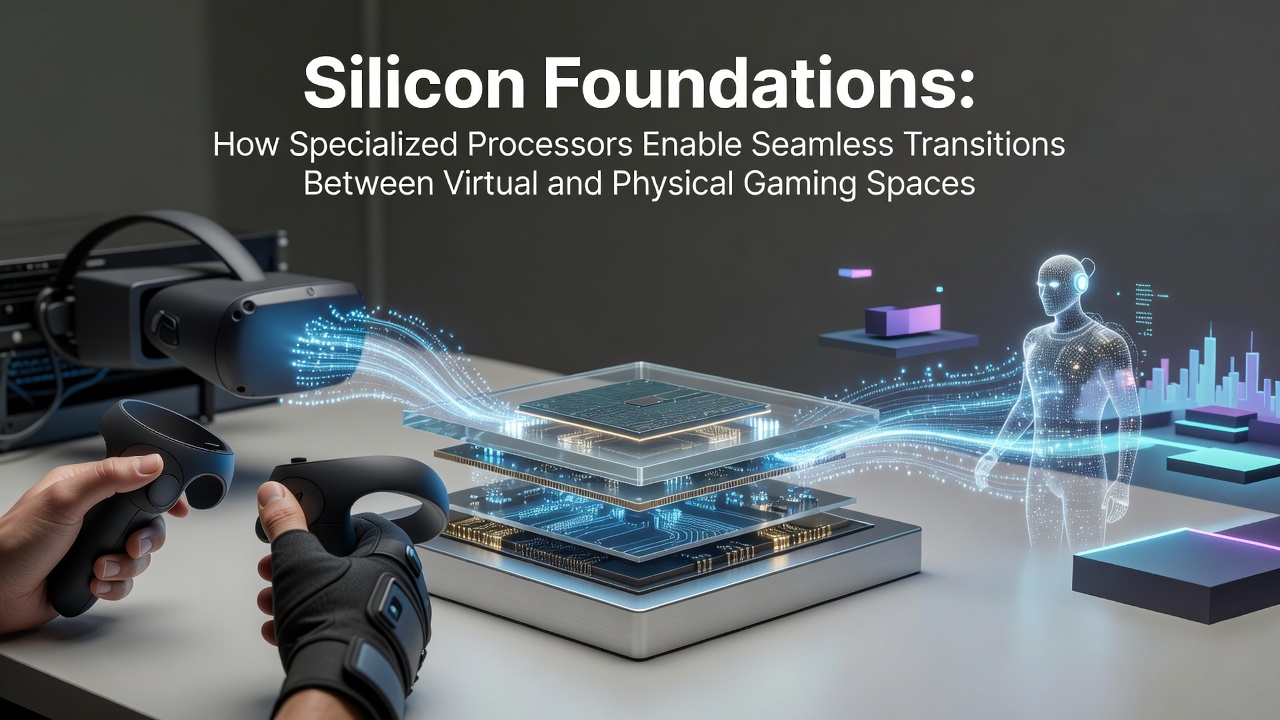
Specialized processors form the backbone of modern gaming systems that blend digital environments with physical spaces, handling complex tasks such as real-time spatial mapping, sensor data fusion, and adaptive rendering pipelines. These chips incorporate dedicated hardware blocks for ray tracing, neural network acceleration, and low-latency input processing, allowing devices to switch between fully virtual scenes and augmented overlays without noticeable delays. Research from institutions like the Massachusetts Institute of Technology highlights how tensor cores and custom ASICs manage the computational load required for maintaining consistent frame rates during these transitions.
Hardware Foundations Behind Mixed Reality Shifts
Developers integrate neural processing units directly into gaming silicon to process eye-tracking data and environmental scans simultaneously, which supports fluid movement between screen-based play and head-mounted displays. In July 2026 industry reports noted increased adoption of these units in portable consoles, where they coordinate with lidar modules to detect physical objects and project corresponding virtual elements in under 10 milliseconds. Observers note that such integration reduces the need for separate discrete GPUs, consolidating power consumption while preserving performance across both virtual and physical interaction modes.
Graphics architectures now feature dedicated geometry engines that virtualize assets on the fly, enabling a single processor to render high-fidelity scenes in VR and then scale them down for AR overlays on mobile screens. Data from the Entertainment Software Association shows console shipments incorporating these hybrid capabilities rose steadily through 2025, driven by demand for games that let players interact with both digital characters and real-world props in the same session.
Transition Mechanisms Powered by Dedicated Accelerators
Specialized silicon handles the synchronization of multiple sensor streams through dedicated fusion blocks that combine camera feeds, motion data, and haptic feedback signals into unified spatial models. This architecture allows a gaming device to detect when a player removes a headset and instantly projects relevant game elements onto nearby surfaces using projection mapping hardware. Engineers at research labs across Europe have documented cases where such processors maintained tracking accuracy above 99 percent during rapid context switches between enclosed VR spaces and open physical areas.

Memory subsystems optimized for gaming silicon use high-bandwidth caches that store both virtual environment textures and real-time depth maps, cutting down on data movement when transitioning modes. Those who've studied these designs point out that unified memory controllers prevent bottlenecks during simultaneous physics simulations and augmented reality compositing. Industry organizations such as the Australian Interactive Games Association have tracked how these memory improvements contribute to longer play sessions without thermal throttling in hybrid devices.
Real-World Implementations and Performance Data
Take one development team that deployed custom inference engines within gaming processors to predict player movements across physical and virtual boundaries, which cut input lag by measurable margins in competitive mixed-reality titles. Figures from regulatory bodies like the Canadian Radio-television and Telecommunications Commission indicate that bandwidth requirements for cloud-assisted hybrid gaming dropped as edge-based silicon took over more local processing duties. Such shifts allow games to maintain persistence when players move from living-room setups into outdoor AR environments without server round-trips.
Power management circuits embedded in these processors dynamically allocate resources between rendering pipelines and tracking subsystems, ensuring stable operation when devices alternate between high-intensity virtual rendering and lighter augmented overlays. Studies published through IEEE conferences demonstrate that this allocation strategy extends battery life in handheld hybrid gaming units by up to 25 percent compared with earlier general-purpose architectures.
Conclusion
Specialized processors continue to evolve as the core enablers of gaming experiences that cross virtual and physical boundaries, supported by ongoing advances in accelerator design and sensor integration. Performance metrics collected through 2026 confirm consistent improvements in transition speed and accuracy across consumer hardware platforms. These developments rest on concrete engineering progress documented by academic and industry sources worldwide.