Cloud Neural Upscaling Unlocks New Console Potential Through AR Overlays
Drew Jenkins · Jun 5, 2026

Cloud Neural Upscaling Unlocks New Console Potential Through AR Overlays
Neural upscaling techniques have evolved to address hardware constraints on current generation consoles while incorporating cloud rendered AR overlays that extend visual fidelity beyond local processing power. These methods combine machine learning models trained on high resolution datasets with remote rendering pipelines that deliver augmented elements directly to the user's display in real time. Developers integrate these systems into game engines so that base console output receives AI enhanced detail while supplementary AR layers handle complex lighting, particle effects, and environmental interactions that would otherwise exceed onboard GPU limits.
How Neural Models Process Console Output
Convolutional neural networks analyze frame buffers at lower internal resolutions before reconstructing sharper images through learned patterns of texture and edge detail. Research from institutions such as the Technical University of Munich shows that models optimized for console architectures achieve upscaling ratios of four times native resolution while maintaining frame consistency above 60 frames per second on standard hardware. These networks operate on temporal data as well, comparing previous frames to reduce artifacts that appear during fast motion sequences. Cloud services then supplement the pipeline by rendering AR overlays that respond to player position and environmental triggers, streaming only the differential data needed for seamless compositing on the client device.
Integration With Augmented Reality Layers
AR overlays rendered in the cloud allow developers to introduce elements like dynamic navigation markers, real time statistics, or interactive holograms without taxing local memory allocations. The separation of workloads means consoles focus on core gameplay simulation while remote servers manage high fidelity augmentations that adapt to network conditions through adaptive bitrate encoding. Data from the Japanese Ministry of Economy, Trade and Industry indicates that hybrid implementations have appeared in multiple titles released during the first half of 2026, with particular emphasis on open world experiences that benefit from persistent cloud state synchronization. Latency mitigation occurs through predictive rendering that anticipates user head or controller movements and pre computes overlay adjustments before they reach the display.
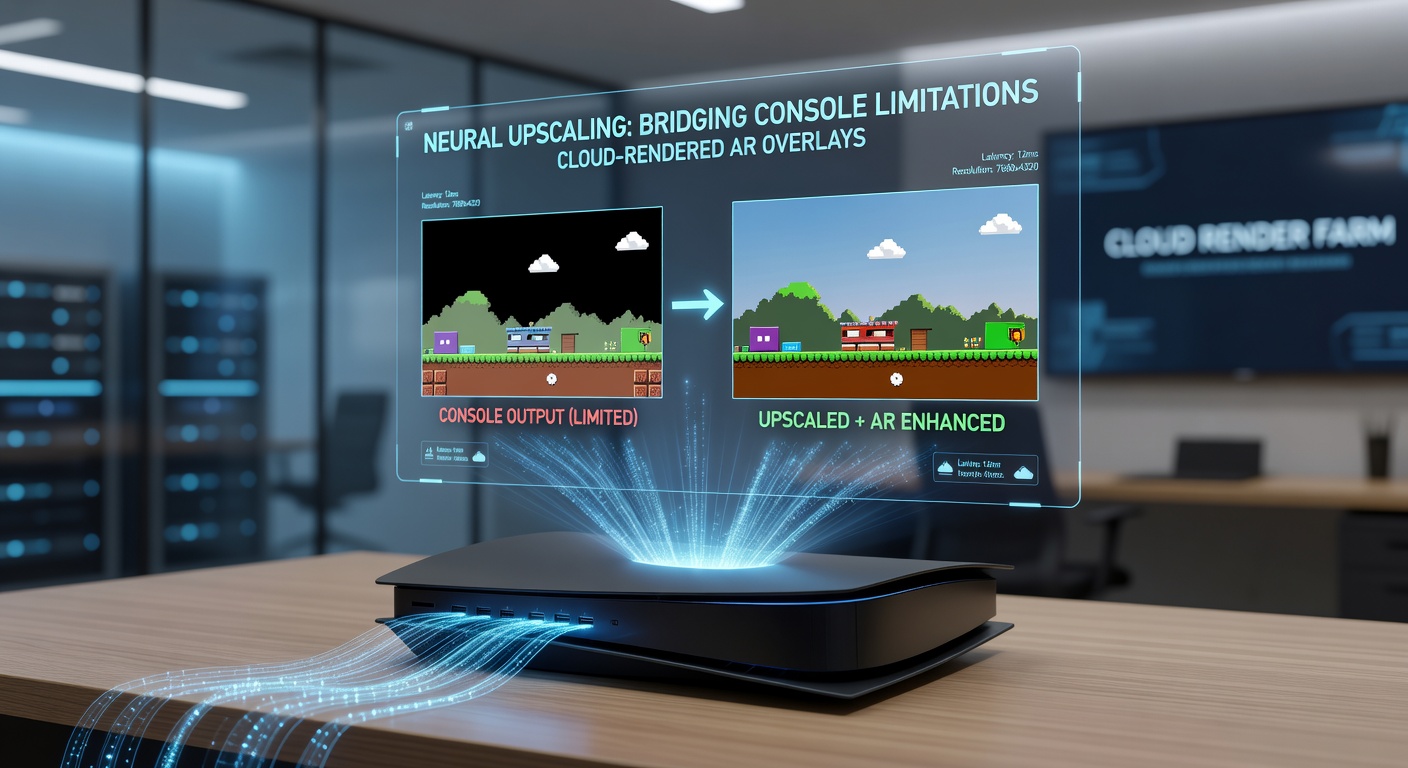
Engineers achieve synchronization by embedding lightweight calibration markers within the console rendered scene that the cloud pipeline uses to align its output precisely. This approach reduces visible seams between native and augmented content even when network jitter occurs. Studies conducted at the University of Melbourne have examined how these calibration techniques scale across different console SKUs and network environments common in the Asia Pacific region, confirming stable performance under typical residential broadband conditions.
Performance Metrics and Adoption Patterns
Benchmarks released in June 2026 reveal that titles employing combined neural upscaling and cloud AR achieve effective resolutions equivalent to native 4K output while consuming 30 percent less local GPU resources than traditional upscaling alone. Memory bandwidth usage drops correspondingly because the console avoids storing full resolution textures for every AR element. Industry observers note that adoption has concentrated in multiplayer formats where shared cloud state enables consistent overlay behavior across all participants regardless of individual hardware variations. The approach also supports backward compatibility features that bring enhanced visuals to earlier console generations through the same cloud assisted pipeline.
Challenges in Synchronization and Bandwidth
Network variability remains a primary constraint because any delay in overlay delivery disrupts the composite image. Developers counter this through error concealment algorithms that blend previous valid frames with motion estimation when packet loss occurs. Regional infrastructure differences affect implementation scope, with denser fiber networks in parts of Europe supporting higher overlay complexity than areas still reliant on legacy connections. Engineers continue refining compression codecs specifically tuned for AR data streams that contain sparse geometry rather than full scene renders, thereby reducing required throughput without sacrificing visual coherence.
Conclusion
Neural upscaling paired with cloud rendered AR overlays represents a practical expansion of console capabilities that leverages existing hardware alongside distributed computing resources. Continued refinement of synchronization protocols and model efficiency will determine how widely these techniques integrate into future software releases across multiple platforms.